
Automating the loading and unloading of a machine tool is no longer an unusual task. It gets more challenging once automation isn't meant to stop at a single machine: workpieces need to move on to the next processing station, one robot system needs to serve multiple machines, or existing equipment needs to be connected flexibly after the fact.
Automated machines alone don't add up to automated manufacturing. Mobile robotics can flexibly connect transport, handling, and machine tending – making automation available exactly where it's needed in the production process. At AMB 2026 in Stuttgart (September 15–19, Hall 6, Booth C55), BEC shows how different that can look depending on the task: from straightforward workpiece transport to mobile handling of parts with a payload capacity of up to 300 kg.
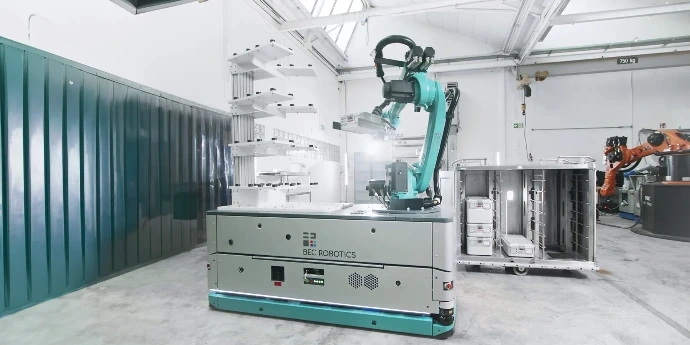
What Actually Needs to Become Mobile?
The answer is rarely the same twice. Depending on the shop floor, it can mean
- transporting workpieces between processing stations,
- automatically loading and unloading machines,
- delivering material where it's needed,
- operating multiple machines with a single robot system,
- handling parts between process steps,
- palletizing,
- connecting a buffer store,
- retrofitting existing machines for automation, or
- handling parts ranging from light to very heavy.
Not every one of these tasks calls for the same technology – and this is where a clear distinction pays off. With pure workpiece transport, it's mainly the load that moves: an autonomous mobile platform carries a part or load carrier from one station to the next without gripping anything itself. If the system also needs to grip, load or unload a machine, or handle pallets, a mobile manipulator comes into play – this is where the robot actually comes to the machine. For manufacturing, that means: not every task needs a robot arm on the platform. But many tasks can only be automated in the first place through mobile manipulation.
The Application Defines the System
This distinction leads to a clear progression of mobile automation:
- Autonomous material transport. An autonomous mobile platform transports workpieces, pallets or load carriers between production and processing stations – reliably and without additional handling functions.
- Mobile manipulation. By integrating a robot arm, the mobile platform becomes a flexible handling system that autonomously picks, loads and unloads machines, and transfers workpieces or pallets.
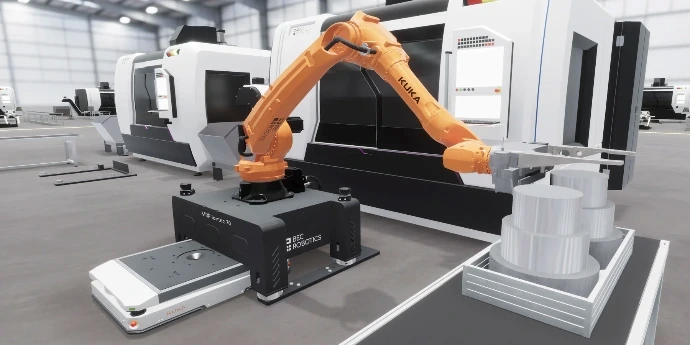
- Heavy-duty mobile manipulation. For heavy components, tools and load carriers, proven industrial robot technology is combined with autonomous mobility – bringing high-payload manipulation to wherever it is needed on the shop floor.
This progression determines which system fits an application – not the other way around.
From Light-Duty Manipulation to 300 kg Payload Capacity
In practice, that means:
- Workpiece transport between processing stations: mobile platforms such as the KUKA KMP 1500 P, which BEC is showing together with KUKA at AMB 2026 (more on this below).
- Mobile manipulation in the light-to-medium range: KMR iisy/iiwa and KMR Cybertech handle loading and unloading, palletizing, and material supply with a payload capacity of up to around 35 kg – compact enough for tight spaces, with inductive charging during operation for continuous use.
- Industrial heavy-payload manipulation: with the MRP platform, BEC makes payload capacities of up to 300 kg mobile.
When Industrial Heavy-Payload Robotics Goes Mobile
The higher the payload capacity, the more demanding it becomes to operate an arm reliably and precisely on a mobile platform. A heavier robot arm brings more mass and more inertia – making it harder to reposition accurately and repeatably after every drive, a challenge classically addressed through camera-based recalibration that can become more error-prone as arm weight increases.
With the MRP platform, BEC takes a different approach: the robot arm and the vehicle are deliberately decoupled. Instead of recalibrating via cameras at every stop, the platform docks at fixed, mechanical docking stations – positioning accuracy becomes repeatable independent of arm weight and payload. This makes it possible to deploy industrial robots such as the KUKA Iontec (payload capacity up to 70 kg) and the KUKA Quantec (payload capacity up to 300 kg) – both originally designed for stationary use – on a mobile platform, with a reach of roughly 3,100 mm.
One important note for practice: a payload capacity of 300 kg doesn't automatically mean a 300 kg workpiece can be handled – grippers, adapters, and other attachments reduce the usable payload and need to be factored into the system design.
This makes it possible to mobilize tasks that were previously reserved for stationary robotics: serving multiple machines with a single robot system, palletizing heavy load carriers, connecting a buffer store, or retrofitting existing machines – without rebuilding the production line.
BEC + KUKA: Mobile Automation at AMB 2026
This whole spectrum – from light-duty manipulation to mobile heavy-payload robotics – is made possible by BEC's long-standing partnership with KUKA: BEC has been a KUKA system integrator for 22 years. The roles are clearly divided: KUKA supplies powerful industrial robot and mobile technologies. BEC develops and integrates application-specific mobile automation solutions from them – from selecting the right system to integrating it into the given production process.
This collaboration can be experienced firsthand at AMB 2026: at its own booth (Hall 6, C55), BEC shows the full spectrum of mobile manipulation, from light-duty handling up to the 300 kg class. Right next door, at the KUKA booth (Hall 6, C51), BEC and KUKA jointly demonstrate the other basic form of mobile automation: pure workpiece transport between processing stations with the KMP 1500 P. Visitors to both booths see, in one place, just how differently mobile automation can look – from transport to heavy-payload manipulation.
Where the Economic Lever Sits
The economic benefit of mobile robotics depends heavily on the specific application. In practice, a few levers tend to recur:
- A mobile system can serve multiple machines or stations instead of dedicating one robot to each machine.
- Existing machines can sometimes be retrofitted without redesigning the entire production line.
- Depending on the application, fixed conveyor infrastructure can be reduced or avoided.
- Repetitive manual handling – especially of heavy or bulky parts – can be automated.
- When loading and unloading no longer depend on staff availability, usable machine runtime tends to increase.
- Mobile systems can adapt more flexibly to changing production requirements than fixed automation.
How much these levers matter in a given case depends on the specific manufacturing situation – a conversation about your particular use case is worthwhile.
Which Task Would You Automate on the Move?
Which machine or process in your production is still dependent on manual handling today? Which task would you like to automate on the move? Bring your use case to AMB 2026 and discuss it with BEC!
BEC booth: Hall 6, Booth C55
The full spectrum of mobile manipulation, from light-duty handling to the heavy-payload class
KUKA booth: Hall 6, Booth C51
Plus the automated workpiece transport via KMP 1500 P
We're happy to schedule a meeting in advance so there's enough time for your specific application. Have we piqued your interest? Get in touch.