Mobile Robot Platform (MRP) — 300 kg Payload with KUKA QUANTEC & IONTEC
Decoupled design – Unlike a mobile manipulator, where the robot is permanently integrated with the mobile platform, the MRP uses a decoupled architecture in which the robot and AMR operate independently. Transporting the robot between workstations is a simple transport task for the AMR, while power, compressed air, and communication are provided via the docking station.
Industry > MRP
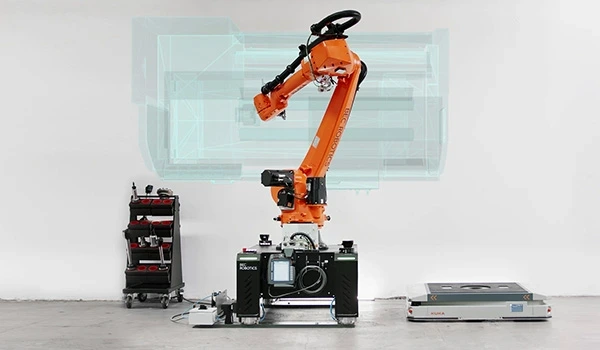
Architecture of the Mobile Robot Platforms
The Mobile Robot Platform (MRP) systems from BEC Robotics combine a robot platform with an autonomous mobile robot (AMR). Where applications require repeatable routes, guided navigation can be integrated into the AMR platform.
The Mobile Robot Platform (MRP) base is equipped with all the components required for autonomous operation. These include a PLC, a robot controller (KRC5), safety sensors, a module for communication with machines and systems, an integrated power supply, and a compressed air storage tank for the docking system.
Immediate Deployment in Production
Environments
Pre-engineered mobile robotic platforms ready for rapid integration into existing production and intralogistics workflows.
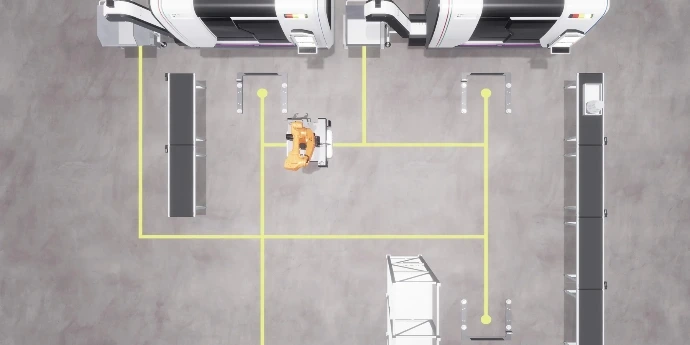
Efficient transport with AGVs
The Mobile Robot Platform (MRP) systems are moved between workstations using automated guided vehicles (AGVs) – for example, the KUKA KMP1500. The vehicles drive under the Mobile Robot Platform (MRP) base, lift it, and autonomously transport it to the desired station. The AGVs are not solely dedicated to transporting the robot platform: after delivering the Mobile Robot Platform (MRP) to the docking station, they are immediately available for other logistical tasks. This increases the overall utilization of the vehicle fleet and improves efficiency.
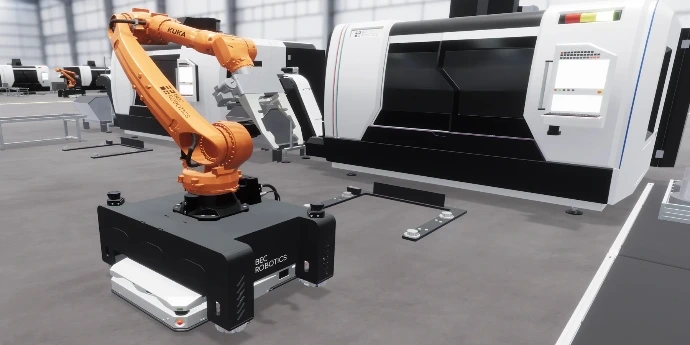
Precise Docking for Maximum Process Reliability
At each deployment location, the Mobile Robot Platform (MRP) automatically connects to a permanently installed docking station. This station handles the mechanical mounting as well as the supply of power, compressed air, and communication connections. All necessary utilities are typically already available on-site, as they are usually required for the operation of the machine or system. This reduces installation effort and allows for easy retrofitting of existing production areas.
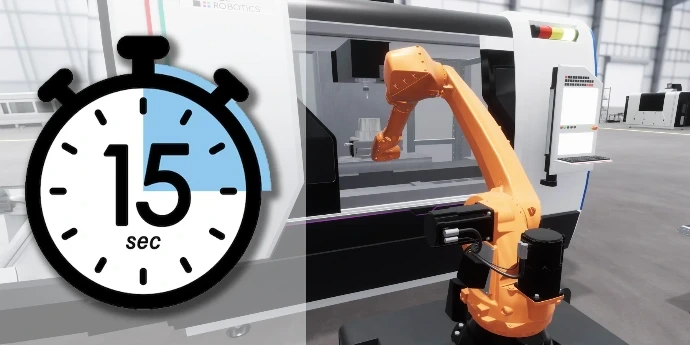
Ready for Use in 15 Seconds
Thanks to its smart system architecture and precisely fitting docking design, the Mobile Robot Platform (MRP) unit is fully operational within just 15 seconds of docking. The Mobile Robot Platform (MRP) simply needs to connect to the docking station. No camera-based referencing or calibration of the robot is required. As soon as the safety area is clear, the robot can directly enter the process – with the precision of a stationary robot, but with complete location independence.
Key Features
The Mobile Robot Platform (MRP) gives you the mobility of an AGV fleet and the precision and payload capacity of a stationary industrial robot, with no compromise on either side. Three features define the system.

Dock & Produce in 15s
Smart docking connects all media. No calibration. Robot enters process in <15 seconds.

Stationary Precision
Mechanical fixation = stationary robot accuracy. No camera correction after docking.

Scalable & Flexible
Add docking stations easily. One Mobile Robot Platform (MRP) serves multiple stations. Future-proof.
Mobile Robotic
Integration
BEC Robotics develops and integrates advanced mobile robotic
automation systems for manufacturing environments. By combining industrial robots, autonomous mobile
robots (AMR), precision docking technology and machine communication systems, our Mobile Robot
Platform (MRP) enables flexible, scalable and efficient production automation across multiple
workstations and production lines.
01
Process Assessment &
Automation Planning
BEC Robotics engineers analyse manufacturing
processes, machine interfaces, material flow requirements and operational
constraints to define the optimal mobile robotic automation concept. Existing
production equipment, control systems and workstation layouts are evaluated to
ensure reliable integration and scalable deployment.
02
Robotic System Engineering
& Integration
Each Mobile Robot Platform (MRP) solution is
engineered using operational and production data before deployment. Robot
applications, docking interfaces, safety systems, machine communication and
workstation integration are configured, tested and validated off-site to reduce
commissioning effort and minimise production disruption.
03
Docking, Commissioning
& Process Validation
Mobile robotic systems are deployed and
commissioned under real production conditions. Docking performance, robot
positioning accuracy, machine communication, safety functions and process
repeatability are verified and optimised together with customer teams to ensure
reliable production readiness.
04
Production Support &
System Optimisation
Following deployment, system performance and
robotic operations are continuously monitored and supported during ramp-up. BEC
Robotics provides technical support, process optimisation and ongoing engineering
assistance to maximise system availability and maintain efficient manufacturing
automation.
Applications
The Mobile Robot Platform (MRP) suits any high-payload robotic task that benefits from flexible positioning across multiple workstations.
Production machines often operate with different cycle times, leaving fixed robot cells underutilised. The Mobile Robot Platform (MRP) moves between machining and production stations as required and docks directly into the process environment. This allows robotic capacity to be shared across multiple machines without modifying existing production layouts.
Large workpieces, tools and assemblies require high payload capacity and stable robot positioning. The Mobile Robot Platform (MRP) combines the mobility of AGV transport with the rigidity of a stationary industrial robot, enabling precise handling processes for payloads up to 300 kg across changing production locations.
Production volumes, packaging formats and line configurations frequently change in modern manufacturing environments. The Mobile Robot Platform (MRP) allows palletising processes to be positioned where they are needed, while permanently installed docking stations provide repeatable robot accuracy and fast deployment within existing material flows.
Automated loading and unloading processes often require robotic handling at multiple transfer points across production and intralogistics areas. The Mobile Robot Platform (MRP) enables robotic processes to be distributed flexibly between conveyor systems, transfer stations and handling zones without dedicated robot installations at every location .
Existing production facilities often have limited space, fixed machine layouts and restricted infrastructure access. The Mobile Robot Platform (MRP) integrates into established manufacturing environments through compact docking stations and autonomous transport, reducing installation effort while enabling scalable robotic automation within operational factories .
Applications
The Mobile Robot Platform (MRP) suits any high-payload robotic task that benefits from flexible positioning across multiple workstations.
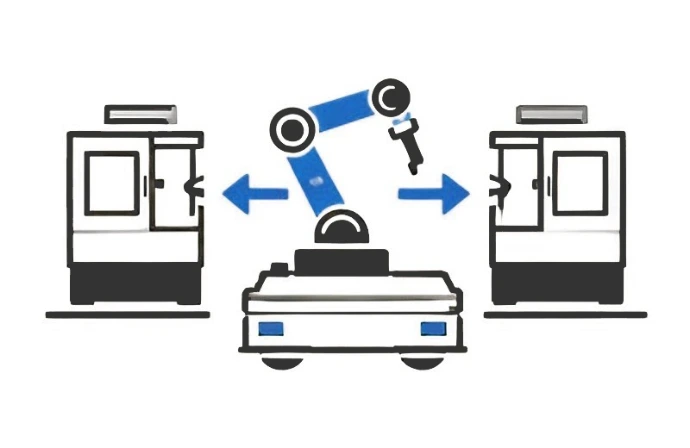
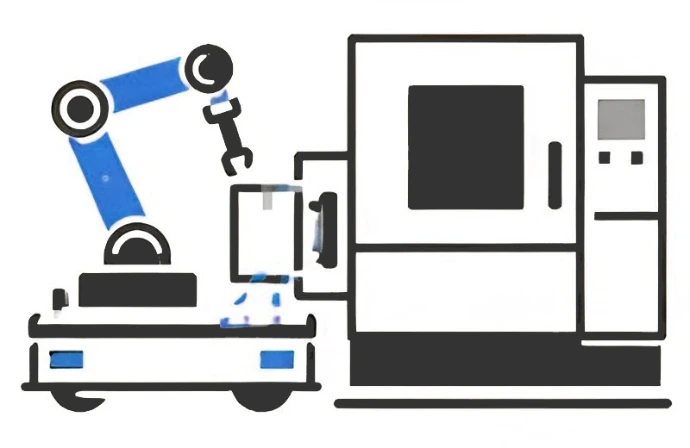
Multi-Machine Tending
Production
machines often operate with different cycle times,
leaving fixed robot cells underutilised. The Mobile
Robot Platform (MRP) moves between machining and
production stations as required and docks directly
into the process environment. This allows robotic
capacity to be shared across multiple machines
without modifying existing production layouts.
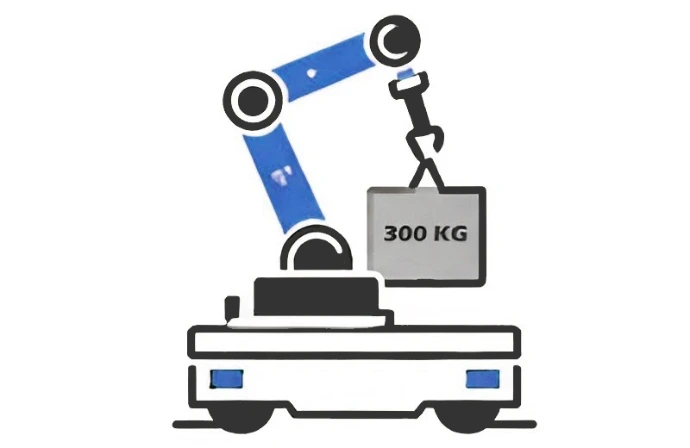
Heavy Component Handling
Large
workpieces, tools and assemblies require high
payload capacity and stable robot positioning. The
Mobile Robot Platform (MRP) combines the mobility of
AGV transport with the rigidity of a stationary
industrial robot, enabling precise handling
processes for payloads up to 300 kg across changing
production locations.
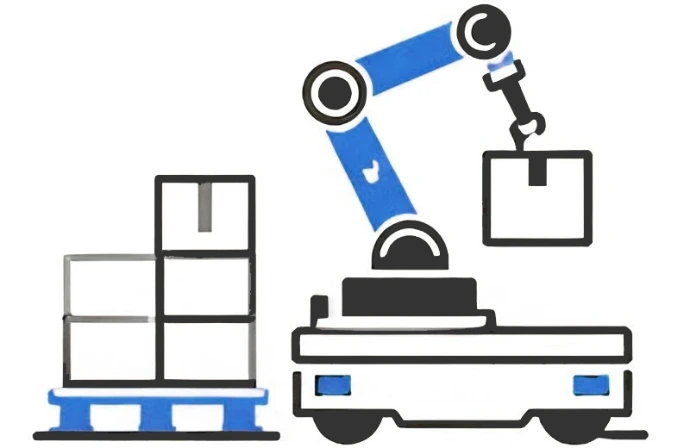
Flexible Palletising
Production
volumes, packaging formats and line configurations
frequently change in modern manufacturing
environments. The Mobile Robot Platform (MRP) allows
palletising processes to be positioned where they
are needed, while permanently installed docking
stations provide repeatable robot accuracy and fast
deployment within existing material flows.
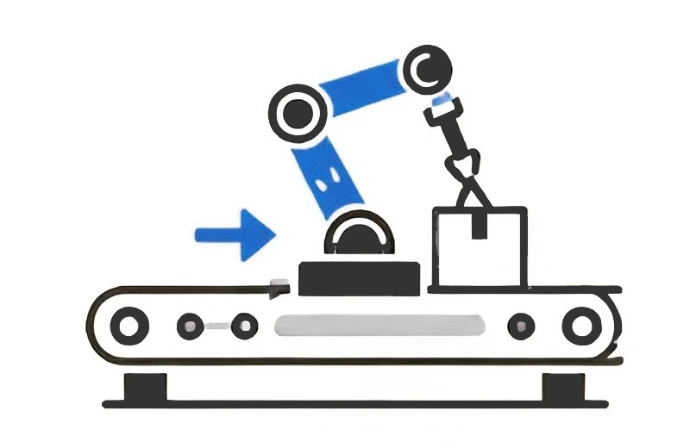
Conveyor & Material Transfer
Automated
loading and unloading processes often require
robotic handling at multiple transfer points across
production and intralogistics areas. The Mobile
Robot Platform (MRP) enables robotic processes to be
distributed flexibly between conveyor systems,
transfer stations and handling zones without
dedicated robot installations at every location.
Brownfield Automation Integration
Existing
production facilities often have limited space,
fixed machine layouts and restricted infrastructure
access. The Mobile Robot Platform (MRP) integrates
into established manufacturing environments through
compact docking stations and autonomous transport,
reducing installation effort while enabling scalable
robotic automation within operational factories.
Projects
Selected projects demonstrating heavy-payload mobile robotics in industrial production and intralogistics environments.
Related Robotics and Automation Services
Explore complementary solutions including mobile robotics, intralogistics systems, and custom automation engineering for industrial applications.
Industrial Automation
Customized automation solutions for industry and manufacturing – from robotics and handling technology to the integration of complete production systems.AGV / AMR
Autonomous transport systems for industry and intralogistics – from compact vehicles for material transport to heavy-duty solutions for demanding manufacturing processes.Mobile Manipulators
KUKA KMR series: mobile manipulators that put a robot arm on an autonomous mobile base. Available in payload classes from 7 kg up to 300 kg.
FABMOVER
The FABMOVER, a cleanroom AMR built for semiconductor fabs. It automates pod and cassette transport and supports SEMI E82 and E84.
Frequently Asked Questions
Answers to common questions about our robotics systems, integration process, and project capabilities.
The MRP is a modular automation concept that decouples the industrial robot from the AGV transport platform. The robot is transported to a workstation by an AGV (such as the KUKA KMP1500) and automatically docks at a fixed docking station. UUnlike conventional mobile manipulators, the MRP concept supports large industrial robots such as the KUKA IONTEC and QUANTEC with payloads of up to 300 kg.
The MRP concept consistently decouples robot, transport, and power supply. The robot operates stationary on a base transported by a standard autonomous mobile platform. Power, compressed air, and data are supplied via the docking station — eliminating battery limitations and the need for massive, heavy integrated carrier platforms.
One robot on one MRP platform can serve multiple workstations in sequence. After the vehicle delivers the MRP to a docking station, the vehicle is immediately available for other logistical tasks. Once the MRP has been delivered to the docking station, the transport platform is available for other tasks.
The MRP is fully operational within just 15 seconds of docking. The smart docking design connects power, compressed air, and data automatically. No camera-based referencing or robot calibration is required after docking — the robot can enter the production process directly with the precision of a stationary robot.
The MRP base includes all components required for autonomous operation:
PLC (Programmable Logic Controller)
KUKA robot controller (modified KRC5)
Safety sensors (laser scanners)
Communication module for machines and systems
Integrated power supply
Compressed air storage tank for the docking system
Mobile Robot Platforms (MRP) are ideal for:
Operating multiple CNC machines or production stations with one robot
Machine interlinking with minimal structural effort
Automating machine tending for multiple production machines
Palletising and depalletising with high unit weights
Handling tasks such as part picking from conveyors and container filling
Easy retrofitting of automation into existing production systems
By enabling one robot to serve multiple workstations, MRP reduces the number of robots and fixed robotic cells required. A single MRP unit replaces what would otherwise require several dedicated fixed robots. Investment in docking stations is significantly lower than purchasing and installing dedicated robot cells at each machine.
Yes. Additional docking stations can be easily integrated into an existing MRP system. Since all necessary utilities (power, compressed air, communication) are typically already available at machine locations, retrofitting new docking stations is straightforward and cost-effective.
The MRP system connects to factory control systems (PLC, MES, ERP) through the MRP's integrated communication module. Its modular architecture allows additional workstations and docking stations to be integrated as production evolves, while the precision docking concept ensures repeatable robot positioning with the performance of a stationary robot.
Contact Form
Discuss your automation project with our specialists and receive a tailored technical response.